MEP takeoff software that reads M, E and P off the same sheet.
One model reads mechanical, electrical and public health services on one drawing and tags every count with the discipline it belongs to. No switching tools, no separate symbol libraries, and no unpicking one bill out of three afterwards.
Clean-up, auto count and auto linear, 42 seconds. Watch it with a scene-by-scene breakdown.
Multi-services, single pass.
An MEP drawing set is not three sets stapled together. Containment crosses pipework, ductwork crosses both, and the coordination drawings sit on top of the lot showing the penetrations and builders work that belong to all three. The takeoff has to separate the disciplines that the drawing deliberately overlays, then keep them separate all the way to the bid.
ZeroCount reads the set in one pass and tags each count with its discipline, so mechanical, electrical and public health come out as three sets of quantities measured off the same geometry on the same day — rather than three takeoffs done at different times, by different people, off different revisions. Counts push into Ensign with the discipline tag intact, so each one prices off the right rate library.
Three disciplines share one sheet, and the overlap is deliberate.
On a coordinated services drawing the disciplines are drawn on top of each other because that is the point of the drawing — it exists to show that the duct, the pipe and the cable tray can all occupy the same ceiling void. Pulling them apart again is the takeoff’s problem, not the drawing’s. A socket outlet sits under a duct run. A tray crosses four pipes inside a metre of drawing. Labels sit over labels, and the one you need is the one underneath.
Symbol-matching tools struggle here for a structural reason. They are looking for a clean shape, and on a services drawing most shapes are interrupted by another service crossing them. Flatten the set to a scan and whatever layer information might have rescued it is gone with the flattening. What is left is a picture, and reading the picture is the job.
ZeroCount tells the services apart from the drawing’s own conventions — line types, colours and layers where the PDF still carries them, labels and symbol conventions where it does not — and tags every count with the discipline it came from. For what gets counted inside each one, see electrical takeoff and mechanical takeoff. This page is about what changes when they arrive together.
Schedules and drawings are two separate counts.
Every discipline on an MEP set brings its own schedules: an equipment schedule for the air handling units and pumps, a distribution board schedule, a sanitaryware and above-ground drainage schedule. They sit on different sheets, use different reference conventions, and get revised on different cycles.
Cross-referencing them means doing the same job three times against three different drawn languages, which is slow, and slow is what gets skipped when the tender is due Thursday. It is also where the useful findings are. A schedule listing six air handling units against five drawn on the plan is either a drawing behind the schedule or a schedule behind the drawing, and either way it is a question worth asking before the price goes in rather than after.
ZeroCount pulls the equipment schedules out of the drawing notes and matches them against the symbol counts on the plan, per discipline. Where the two agree you have a checked quantity. Where they disagree you have both numbers in front of you and a reason to go and ask. Reconciling them is not a measurement job. Which document governs is a design decision, and it is a great deal cheaper to raise at tender than to find out on site.
Coordination gaps surface in the takeoff first.
Coordination and builders work drawings exist because the disciplines get in each other’s way. A wall crossed by a duct, two pipes and a cable tray is four penetrations to somebody, or one builders work opening, depending on how the job was set up — and the difference is priced by whoever read the drawing properly.
Plant rooms concentrate the problem. The density peaks there, the disciplines are stacked hardest, and the plant room layout is often the sheet that got revised after the rest of the set was frozen.
ZeroCount counts service penetrations, holes through walls and plant room content across the trades they affect, rather than measuring them once against one discipline and losing the rest. Where the coordination drawing and the discipline drawings show different routes, you get both measured, which is usually the first hard evidence that the set is not coordinated yet.
One bid, three packages, and the seams between them.
The M, the E and the P land in one tender total, but they are priced as separate packages off separate rate libraries, and the money that goes missing on an MEP bid tends to go missing at the seams. The supply and local isolator to a mechanical plant item. Condensate drainage off the fan coils. Fire dampers where the ductwork crosses a compartment line. Controls and BMS wiring, which every package quietly assumes another one has picked up.
None of that is a measurement problem. It is a scope problem, and scope stays yours to decide. What makes it harder than it needs to be is having the three disciplines measured at different times off different revisions, so the conversation about who prices the isolator happens across two takeoffs that do not describe the same building.
Measuring the set in one pass fixes the part that is fixable: the quantities on both sides of a seam came off the same sheets, and they carry their discipline tag into Ensign so each side prices against its own rate library instead of a single blended total somebody has to unpick. Ductwork and insulation sit at two of the busiest seams on an MEP job, and each has its own page for how those quantities get measured.
Combined services, discipline-tagged.
Combined services on one drawing
Mechanical, electrical, public health — counted in a single pass with services-level breakdowns.
Coordination and builders work
Service penetrations, holes through walls, plant rooms — counted across the trades they affect.
Schedule extraction
Pulls equipment schedules from drawing notes and matches them to symbol counts on the plan.
Multi-discipline pricing
Counts push to Ensign with the discipline tag intact, so prices come from the right rate library.
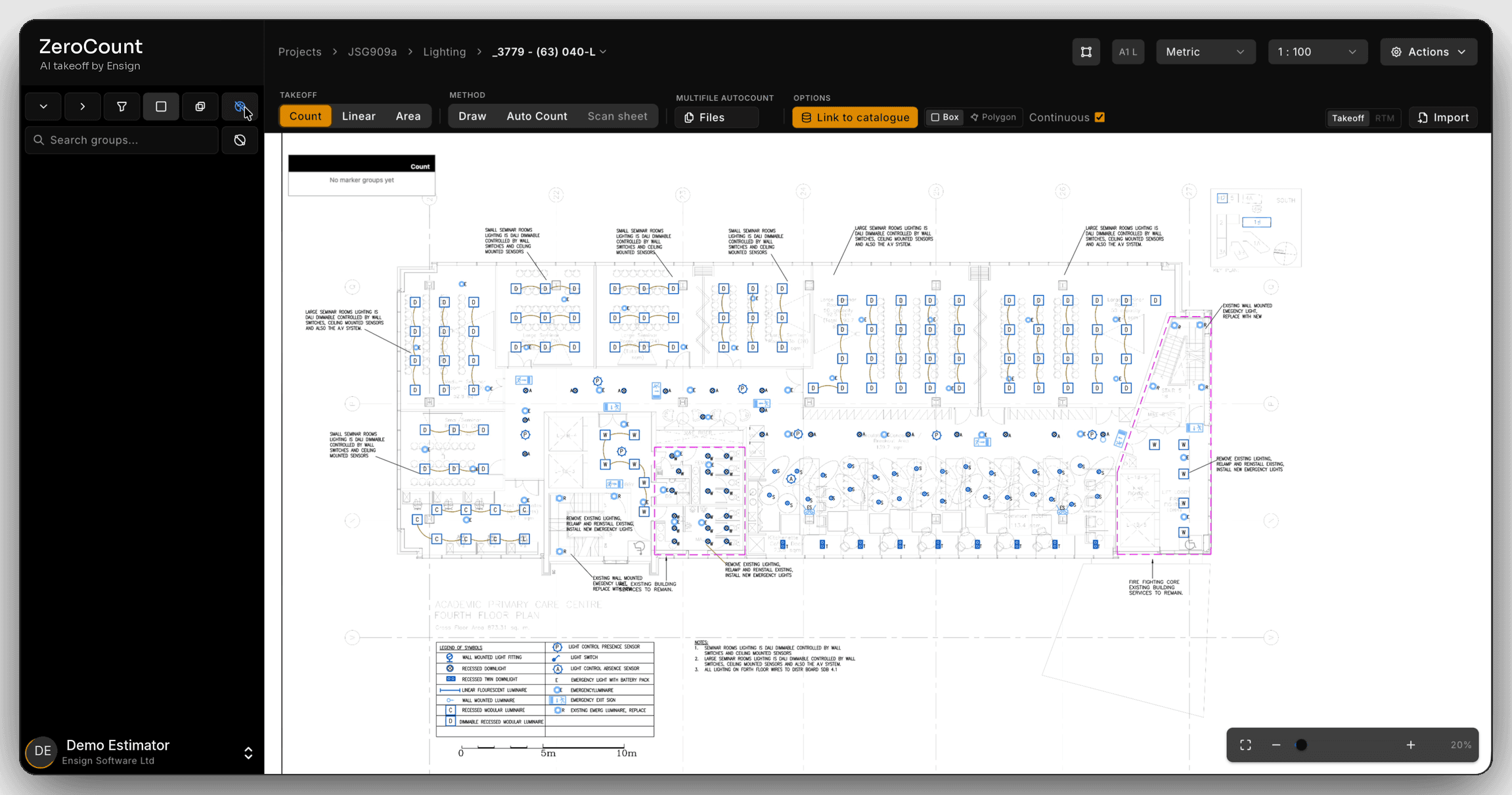
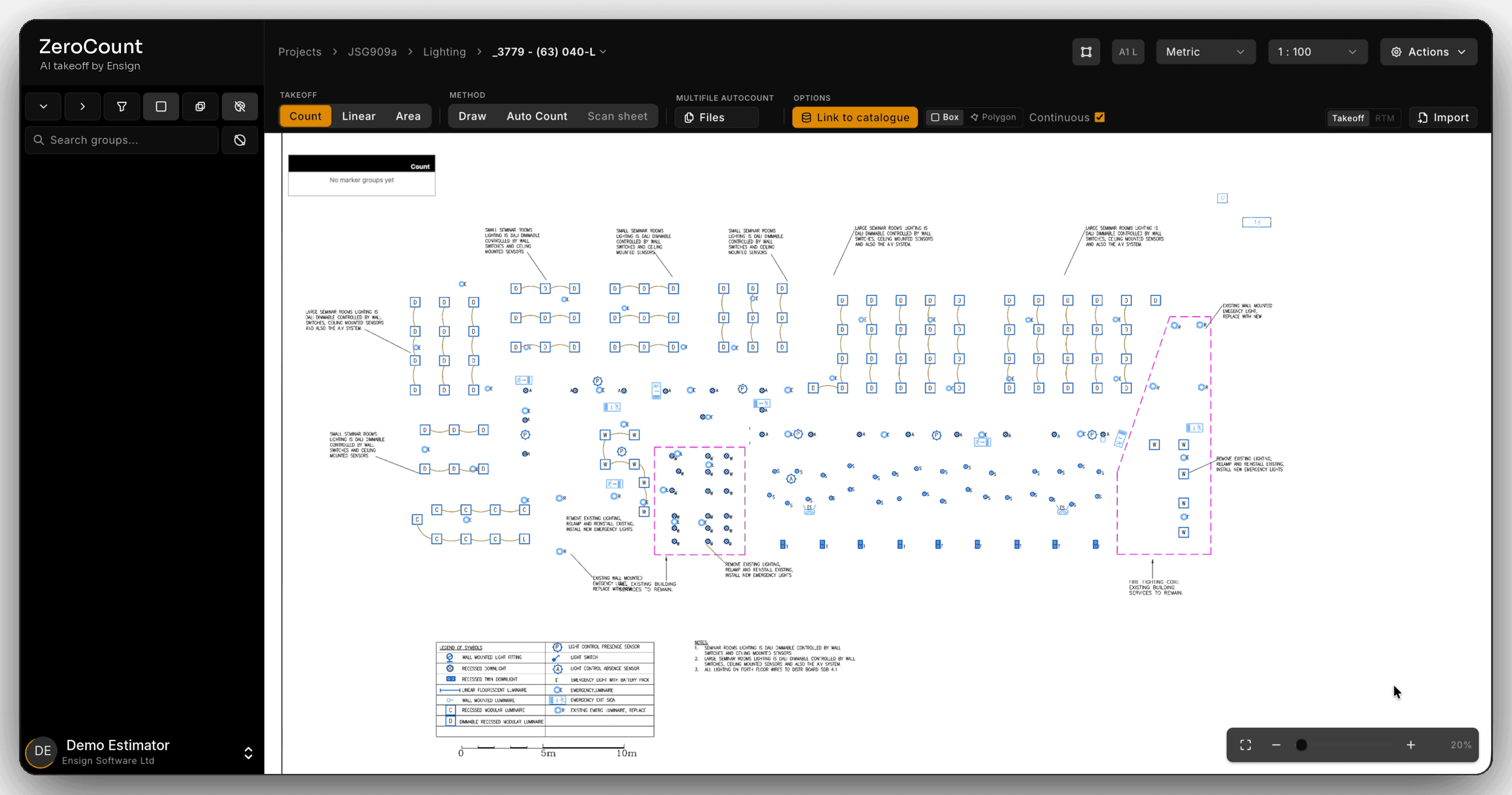
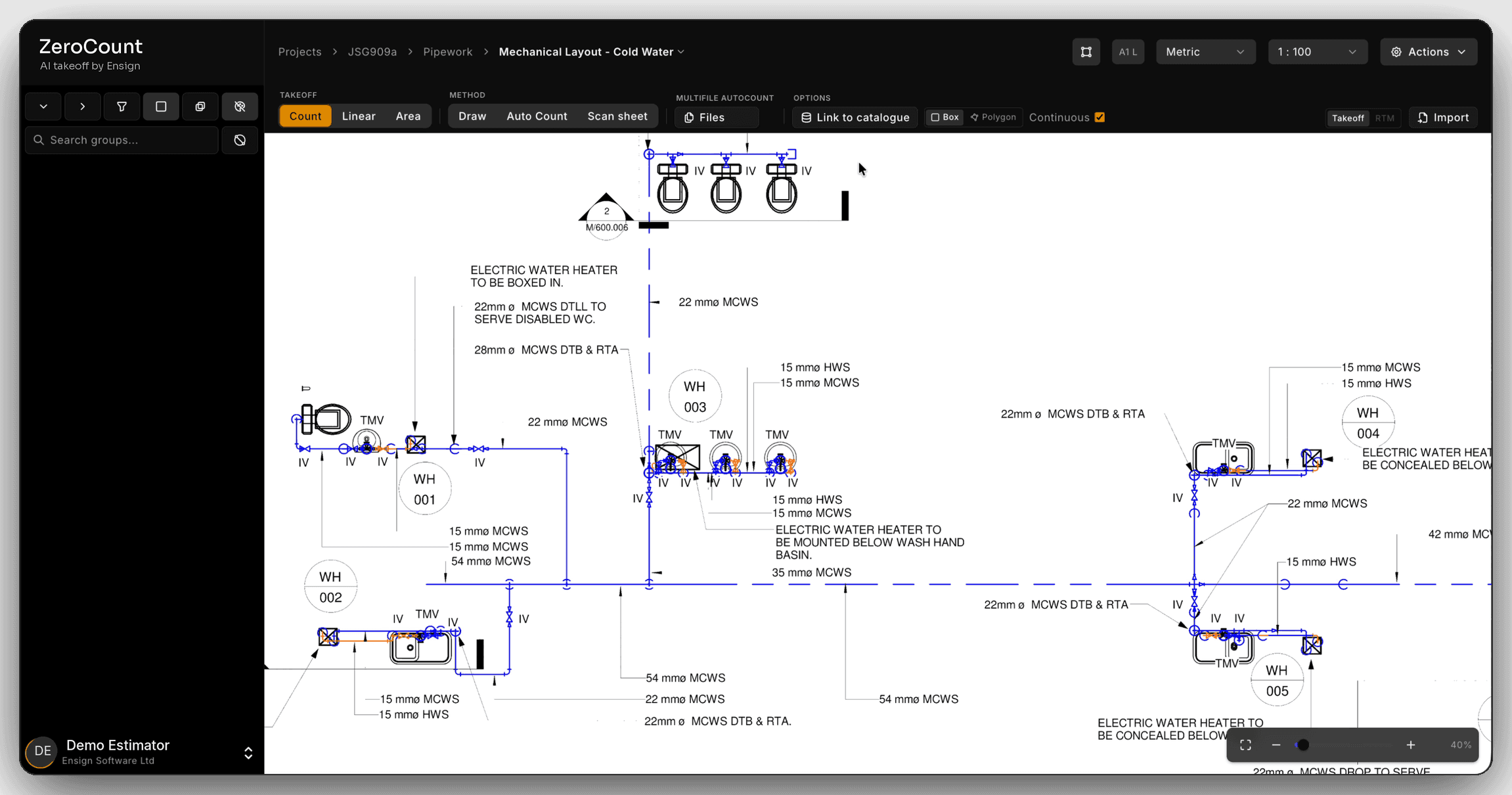
Strip the drawing back to what you are counting.
Background removal takes the walls and furniture off the drawing and keeps the symbols. Click one cable line and every cable line goes with it.
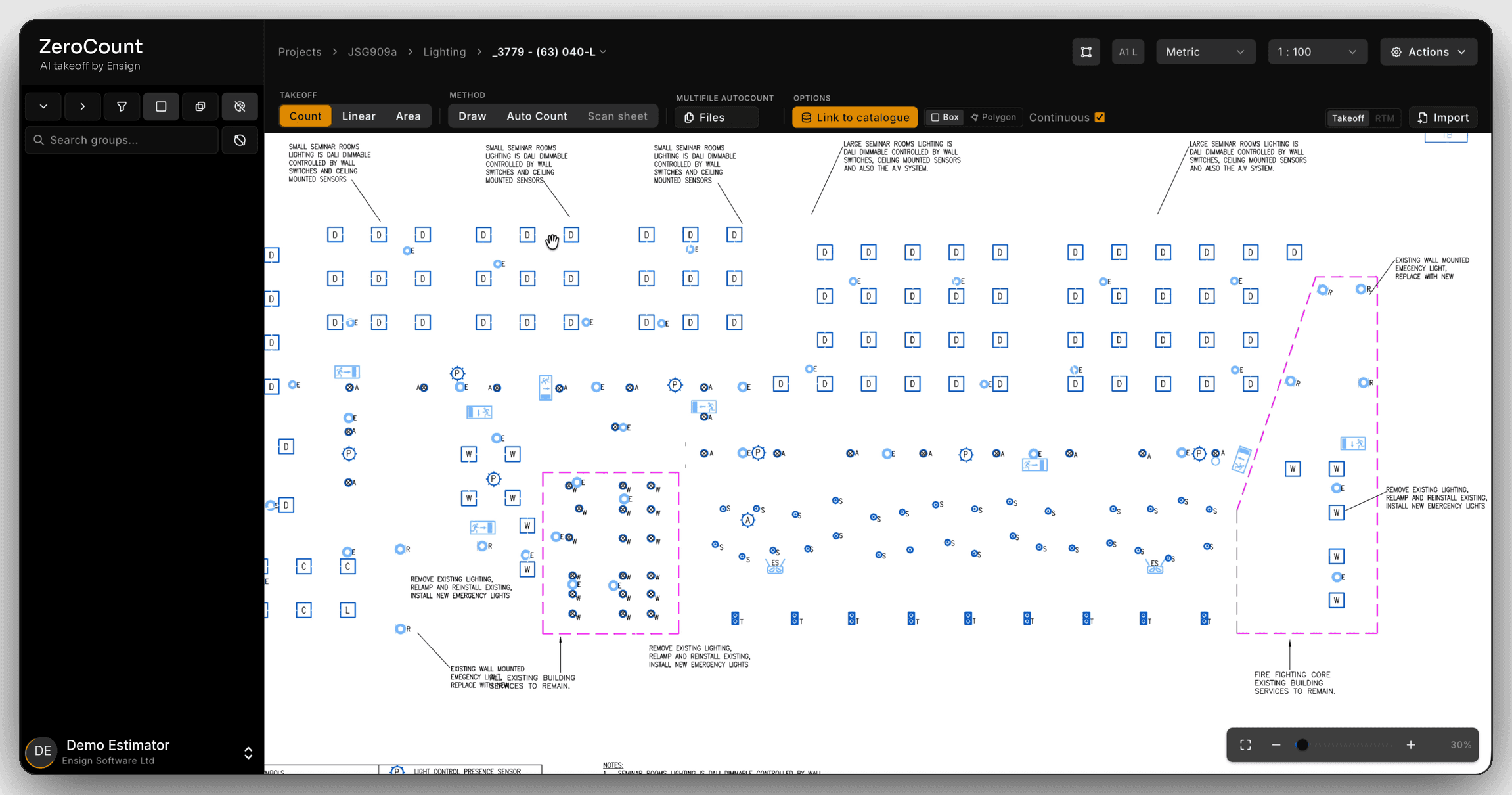
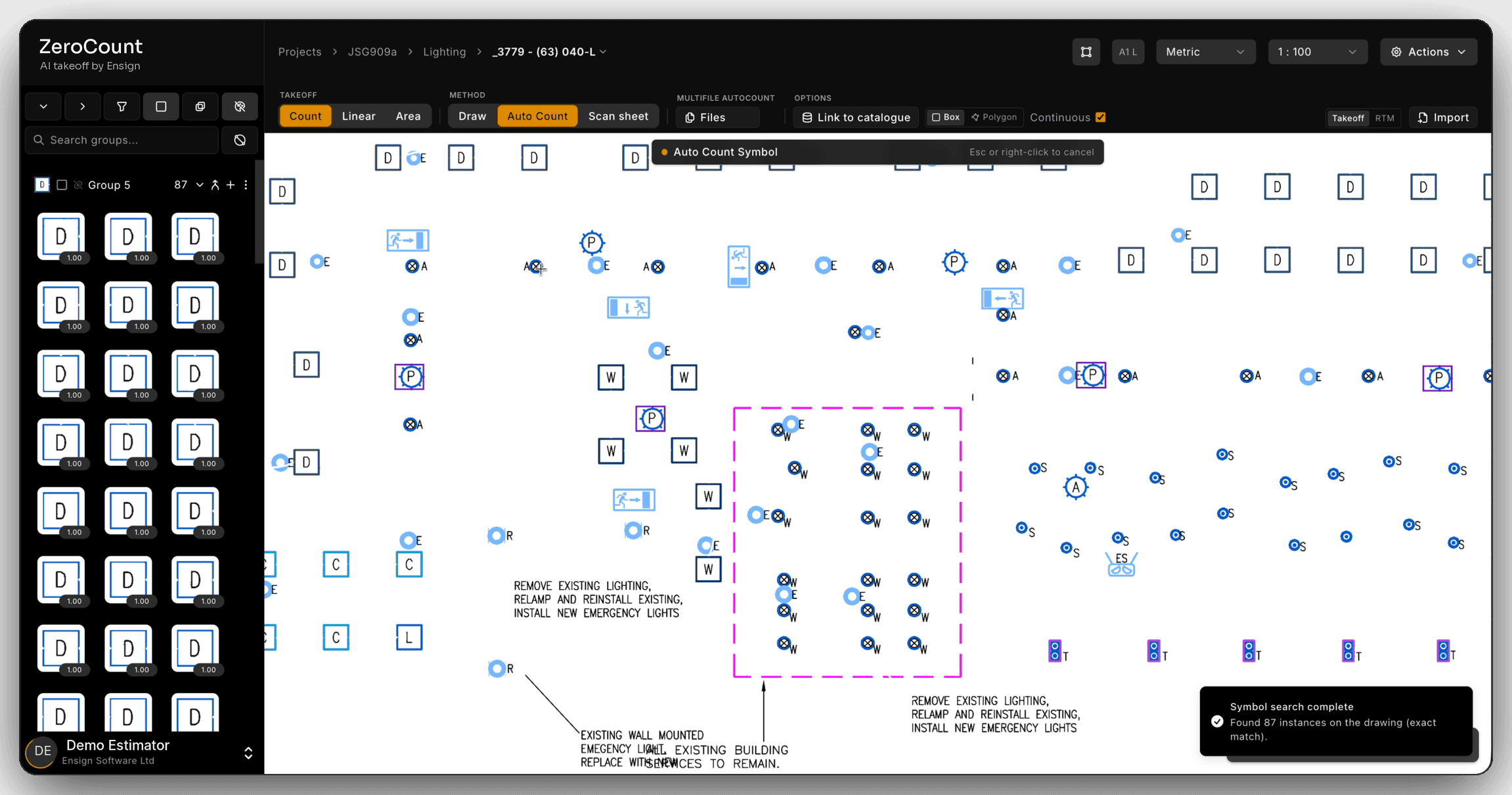
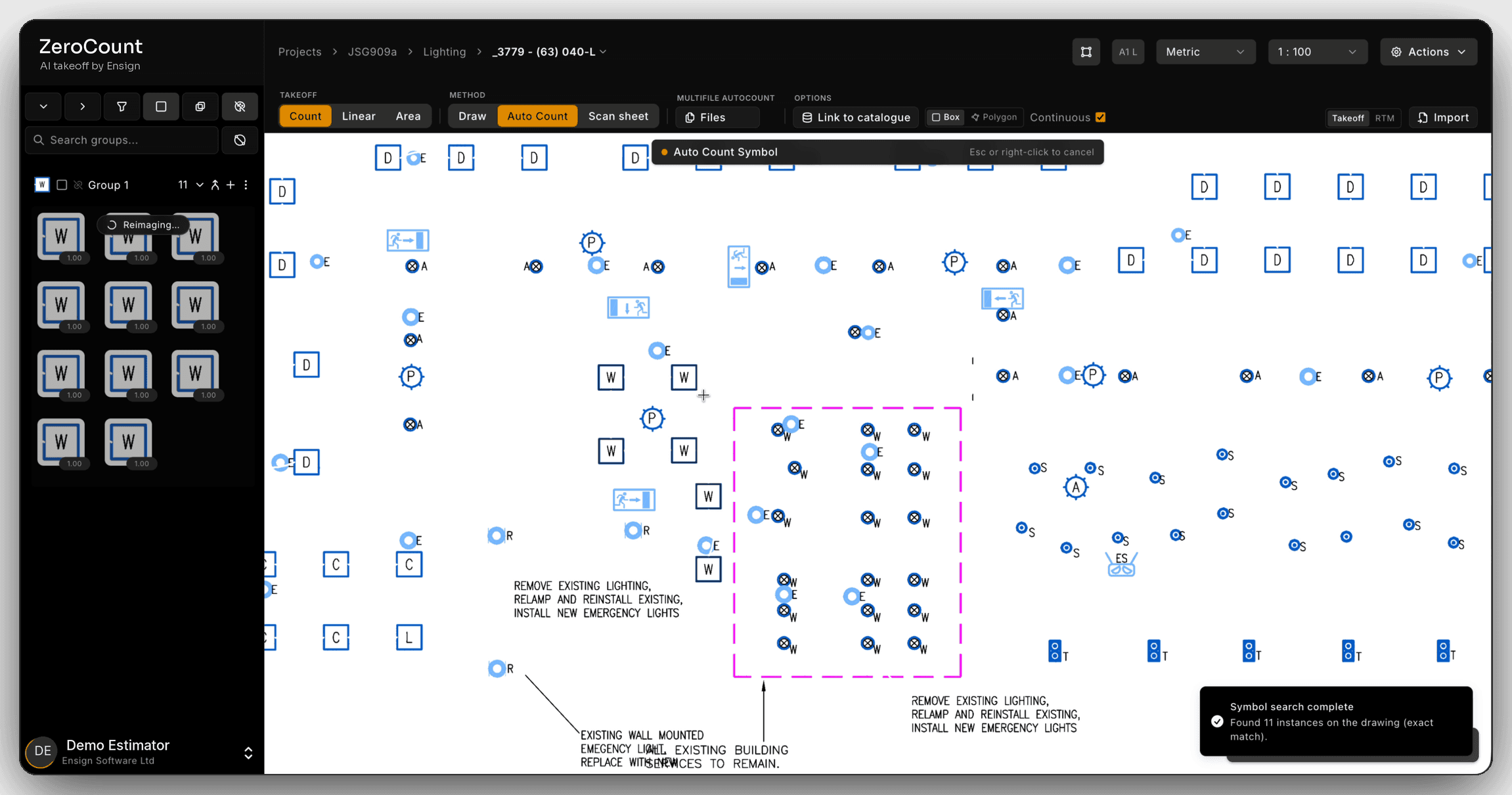
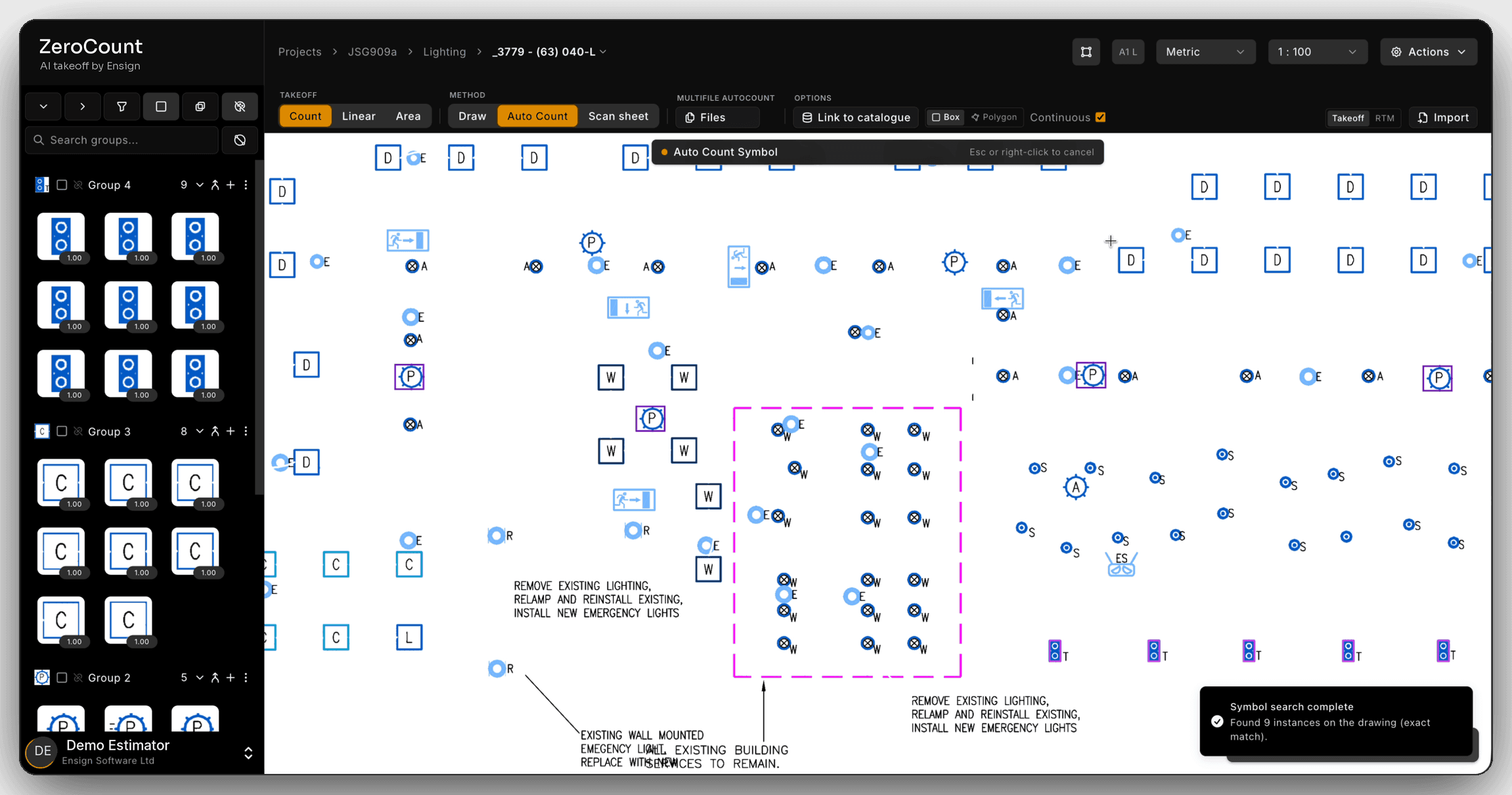
Pick one symbol. Every match is counted.
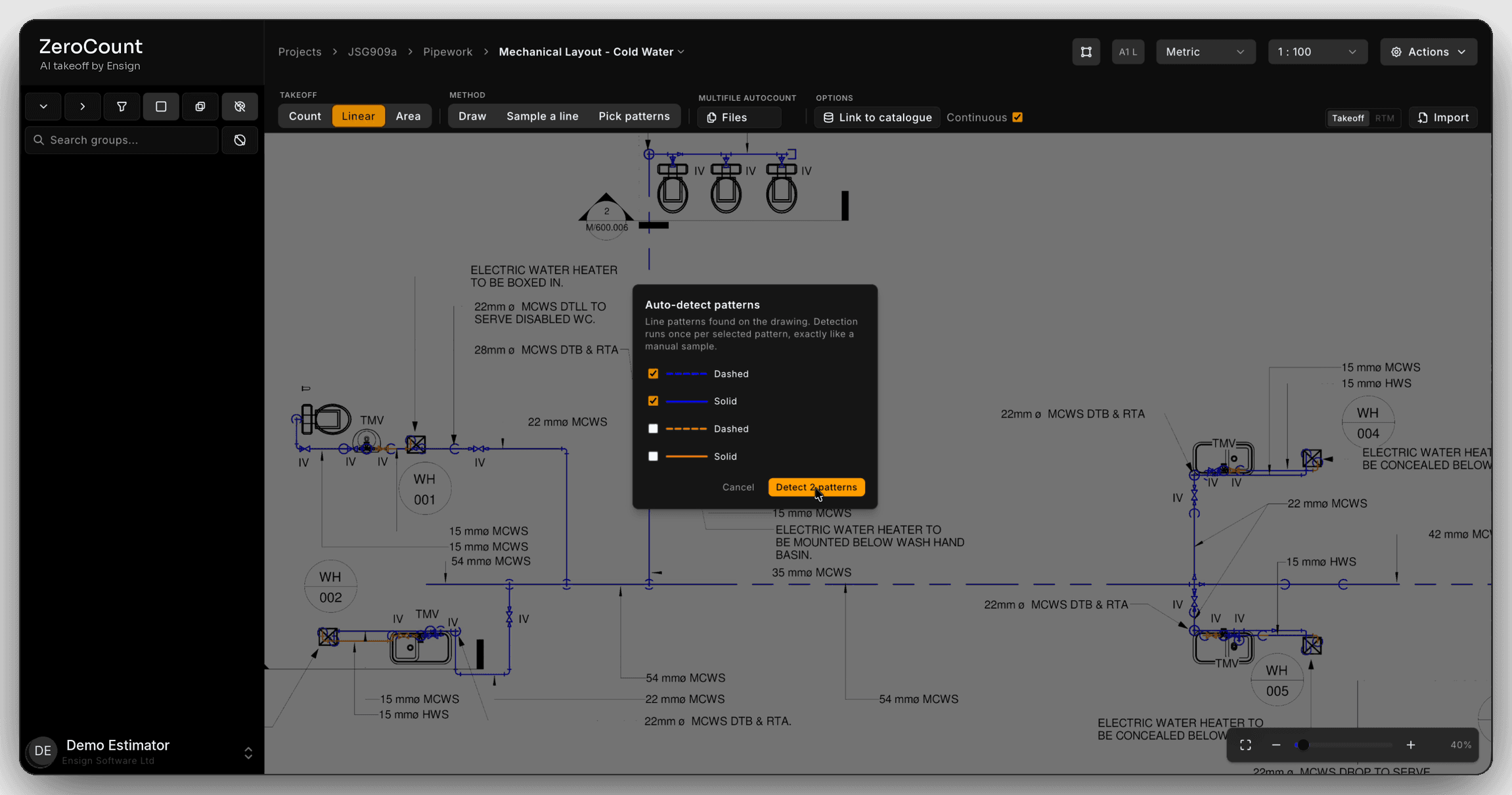
Pick a fitting on the drawing and ZeroCount finds the rest on the sheet, each type in its own group, each match marked where it sits.
Every pipe run traced and sized.
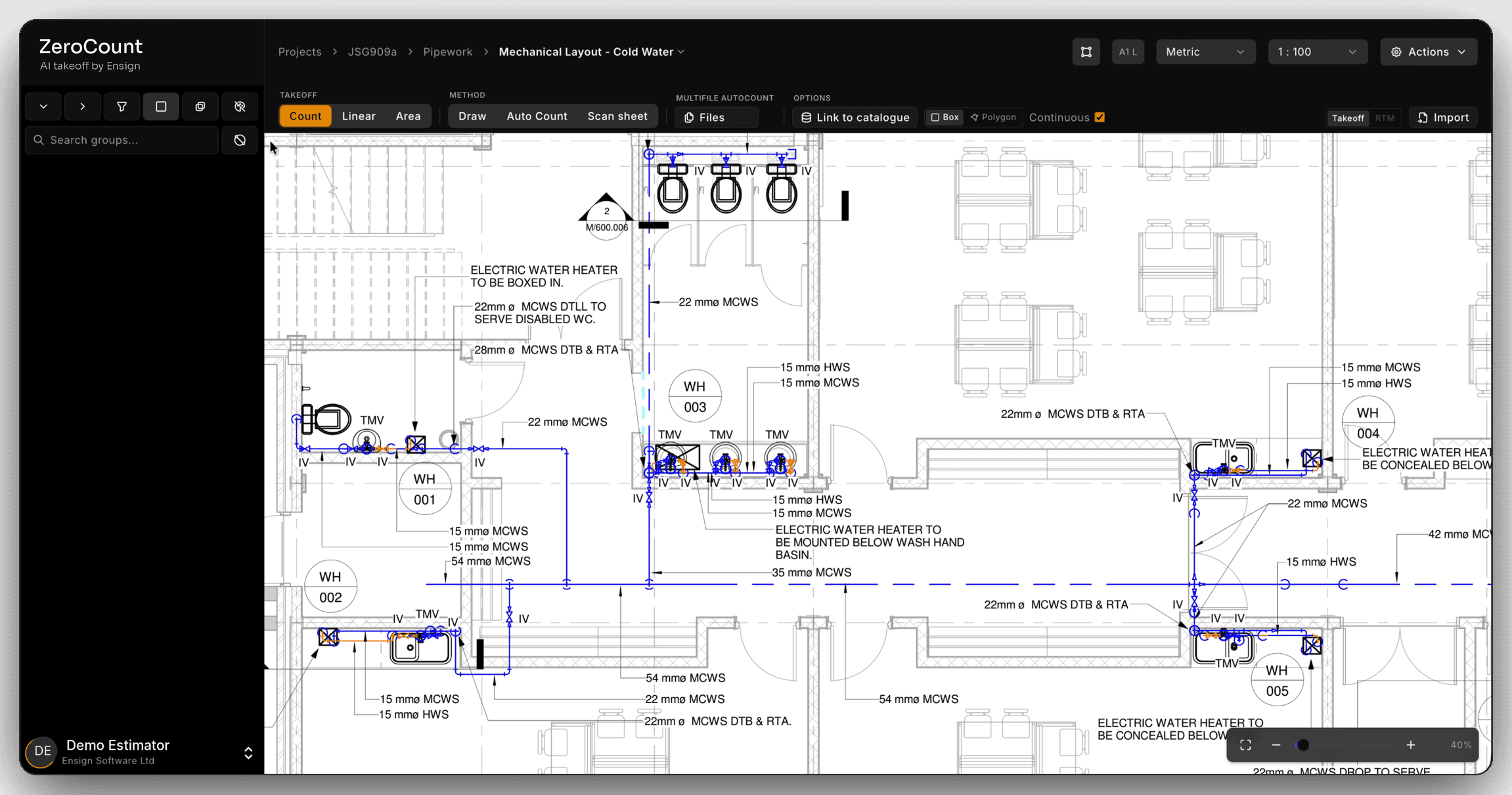
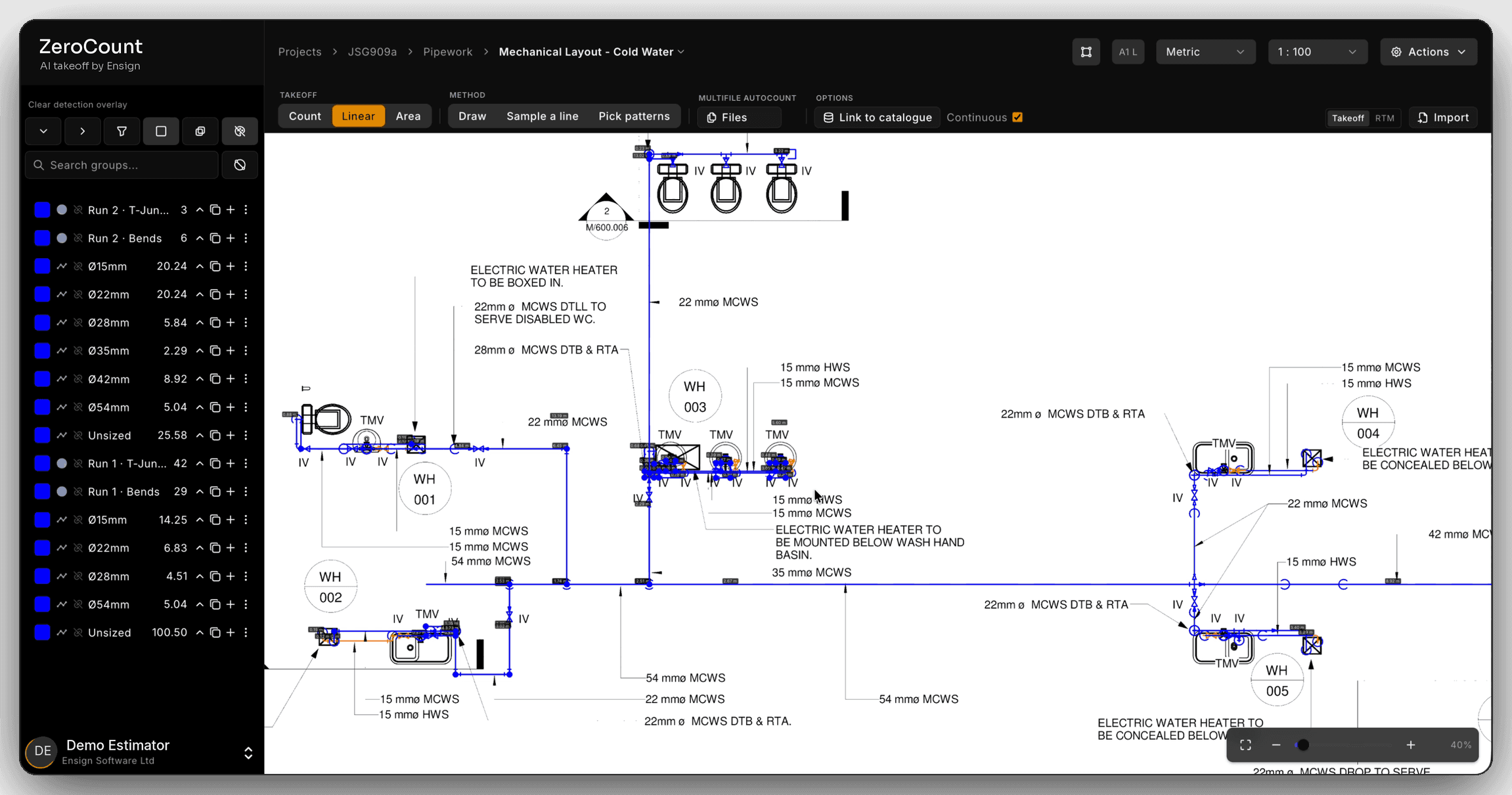
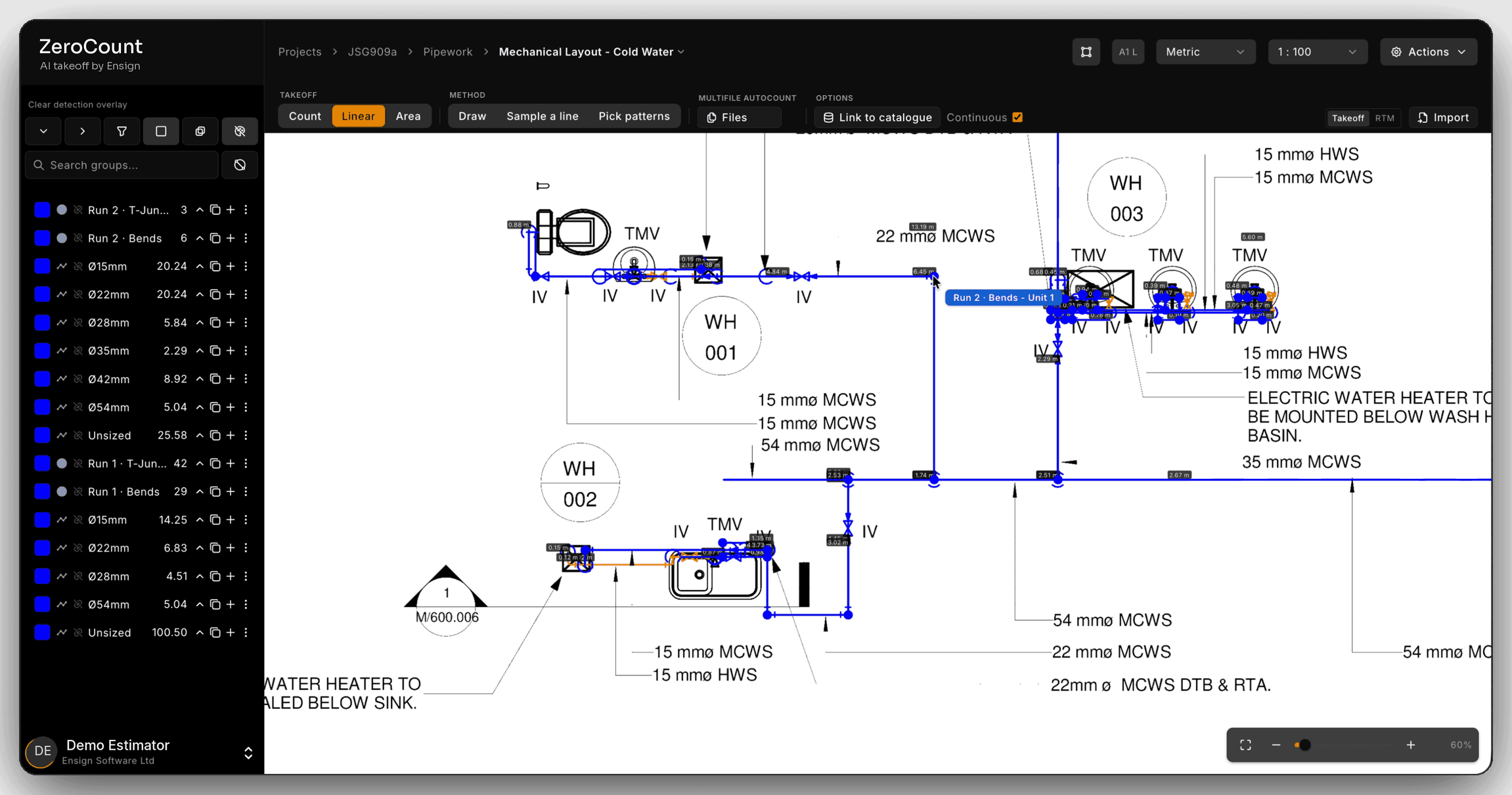
Clear the background, pick the line patterns to follow, and every run is traced and sized from the sizes written on the drawing, with the bends and tees counted along the way.
Quick answers.
- Can it tell the services apart where they overlap on the same sheet?
- Yes. It works off the drawing's own conventions — line types, colours and layers where the PDF still carries them, labels and symbol conventions where it doesn't — and tags each count with the discipline it came from. Overlapping services are the normal case on a coordinated set, not the exception.
- Do I get one set of quantities or one per discipline?
- One per discipline, measured in the same pass off the same drawings. Counts push into Ensign with the discipline tag intact so each set prices off the right rate library, rather than arriving as one blended total you have to split by hand. Excel export is also supported if you price elsewhere.
- Does it read the equipment schedules as well as the plans?
- Yes. It pulls the equipment schedules out of the drawing notes and matches them against the symbol counts on the plan, per discipline. Where the schedule and the plan disagree you get both numbers side by side. Deciding which of the two governs is not something a takeoff engine should be doing for you — but knowing they disagree before you price is worth a lot.
- What about coordination and builders work drawings?
- Service penetrations, holes through walls and plant room content are counted across the trades they affect rather than measured once against a single discipline. What it won't tell you is whose package they belong in — that is a scope decision, and it is yours.
- Do you handle scanned PDFs and photographed plans?
- Yes. Vector PDFs, scanned PDFs and photos of plans on a desk all run through the same engine. A coordinated MEP set is the hardest version of this: flattening it to a scan throws away the layer information that separated the services, so everything arrives as one picture. That is the case worth testing us on.
- How does pricing work?
- £55 per licence per month. No tiers, no enterprise upsell. Multi-licence rates available from five seats — bring the team size to the demo call.
- Innovate UK funded
- ICO registered
- CHAS accredited
- Constructionline
- Built in the UK
See ZeroCount on your own drawings.
Tell us a bit about you and we'll be in touch within one working day to set up a 30-minute walkthrough.