Electrical takeoff software that counts by type, not by symbol shape.
Luminaires split by type, accessories split by variant, containment measured along the route. No symbol library to build first, and no requirement that the drawing be a clean CAD export.
Clean-up, auto count and auto linear, 42 seconds. Watch it with a scene-by-scene breakdown.
What actually makes an electrical takeoff slow.
The counting is not the hard part. What eats the week is everything around it: working out this consultant's symbol dialect, matching type codes to a schedule on another sheet, splitting six socket variants that look identical at 1:100, and following containment through a ceiling void it shares with the duct. Then the revision lands and half of it happens again.
ZeroCount reads UK electrical drawing conventions directly — luminaire types, accessory variants, device categories, containment runs — so there is no symbol library to build before the first count and nothing to rebuild when the next consultant draws it their way. Electrical estimating software that hands back one luminaire total and one length of tray has measured the drawing without answering the question you asked it.
Every consultant draws it differently.
There is a British Standard for electrical symbols and almost nobody follows it to the letter. BS EN 60617 supplies the vocabulary; what each practice does with it is a house style. One consultant draws an emergency fitting as a filled symbol, the next puts a letter beside it, the third gives it a type code and expects you to go to the schedule. Switched fused spurs, twin sockets and floor boxes all pick up their own local shorthand, and the legend on sheet 1 does not always survive to sheet 12.
A human absorbs that in ten minutes. A symbol-matching tool cannot absorb it at all — it has to be told what every mark means before it counts anything, then told again on the next job, by a different consultant, in a different dialect. That is why symbol-based takeoff feels fast on the second drawing of a series and slow on every first one.
ZeroCount reads the convention rather than matching against a library you maintain, so there is nothing to build before the first count. Where it meets a symbol it has not seen it takes one or two corrections instead of a library update, and there is no per-symbol or per-library charge waiting behind that — unlimited symbols is part of the licence.
The luminaire schedule is the drawing's other half.
A lighting layout rarely carries the detail on the plan. The plan carries type codes — L1, L2, EM1, or whatever this practice uses — and the schedule carries what each code actually is: the fitting, the lamp, the output, the emergency provision, the control gear. Neither document prices on its own. What you price is the join between them: how many of type L4, and what an L4 is.
The split that matters most is emergency. A maintained emergency fitting and the standard fitting beside it are often drawn as the same shape with one extra mark, and they carry different rates, different commissioning and a different test regime. Rolling them into a single luminaire total is not a rounding error — it is the part of the bid the margin comes out of.
ZeroCount counts luminaires by type rather than as one figure: Cat 2 panels, downlights, batten fittings and emergency luminaires come out separately, read off the symbol convention rather than off the outline alone. The schedule still tells you what each type is. The drawing tells you how many, and that is the half that takes the hours.
Accessories and devices: the variants that look the same at 1:100.
Small power is where the counting turns tedious. A single socket, a twin socket, a switched fused spur, an unswitched spur, an RCD-protected outlet and a floor box are six rates and, on a busy layout, six near-identical marks. The switch drops do the same: one-gang, two-gang, two-way, intermediate, key switch, retractive. Get the totals right and the variants wrong and the bill is the right size and the wrong money.
Fire alarm and security devices usually share the sheet or arrive as an overlay on it. Smoke detectors, heat detectors, manual call points, sounders and beacons each count as their own line, and on a fit-out they are frequently the fastest-moving part of the drawing between revisions.
ZeroCount counts accessories by variant and devices by category, so what comes back is a breakdown you can price rather than a total you have to unpick first.
Containment is measured along the route, not across the page.
Trunking, tray, basket and conduit are measured by the length of the route, and the route is not a straight line between two points. It follows the structure — around beams, over the grid, down the riser, into the board — and the size steps down as it goes, because a run that leaves the panel as 150mm tray is not still 150mm tray at the last drop. One overall length is not a rate line.
Two things a plan view will not give you. Vertical drops and riser lengths are a dimension the plan does not contain, so they come from the sections, from the levels, or from your own allowance. And on a coordinated sheet the containment route has already been negotiated against everything else in the ceiling void — see MEP takeoff for how the mechanical and public health services sharing that drawing are read.
ZeroCount measures containment runs by colour or layer, with lengths broken down by size. The allowance for drops stays your call, made against a measured drawing rather than a scale rule and a memory.
The state the drawings turn up in.
Electrical drawings are dense before anything happens to them. A lighting layout puts several hundred symbols on a sheet and the difference between two of them can be a single stroke. Then the sheet gets printed, marked up in red by whoever was at the design meeting, scanned at whatever the office machine defaults to, and emailed on as a PDF of a photocopy. By the time it reaches a subcontractor pricing the package it is often a photograph of a print pinned up in a site office.
That degradation lands hardest on exactly the marks carrying the information: the annotation next to the socket, the letter inside the luminaire symbol, the type code set in 2mm text. A symbol library assumes crisp vector geometry, and by this point there is none left to match against.
ZeroCount runs vector PDFs, scanned PDFs and photographs of drawings through the same engine. What that does to a 200-dpi scan has a page of its own; the short version is that the messy formats are the point. If there is a drawing sitting in your inbox that your last takeoff package could not make sense of, that is the one to bring to the demo.
Counted by category, ready to price.
Luminaires by type
Differentiates Cat 2, downlights, emergency luminaires, batten fittings — by symbol convention, not just shape.
Sockets, switches, fittings
Single, twin, fused, switched. The model knows the conventions on UK electrical drawings.
Fire alarm + security devices
Smoke detectors, heat detectors, MCPs, sounders, beacons. Counts by category and totals.
Containment and cable runs
Measure trunking, tray, and basket runs by colour or layer. Lengths broken down by size.
Strip the drawing back to what you are counting.
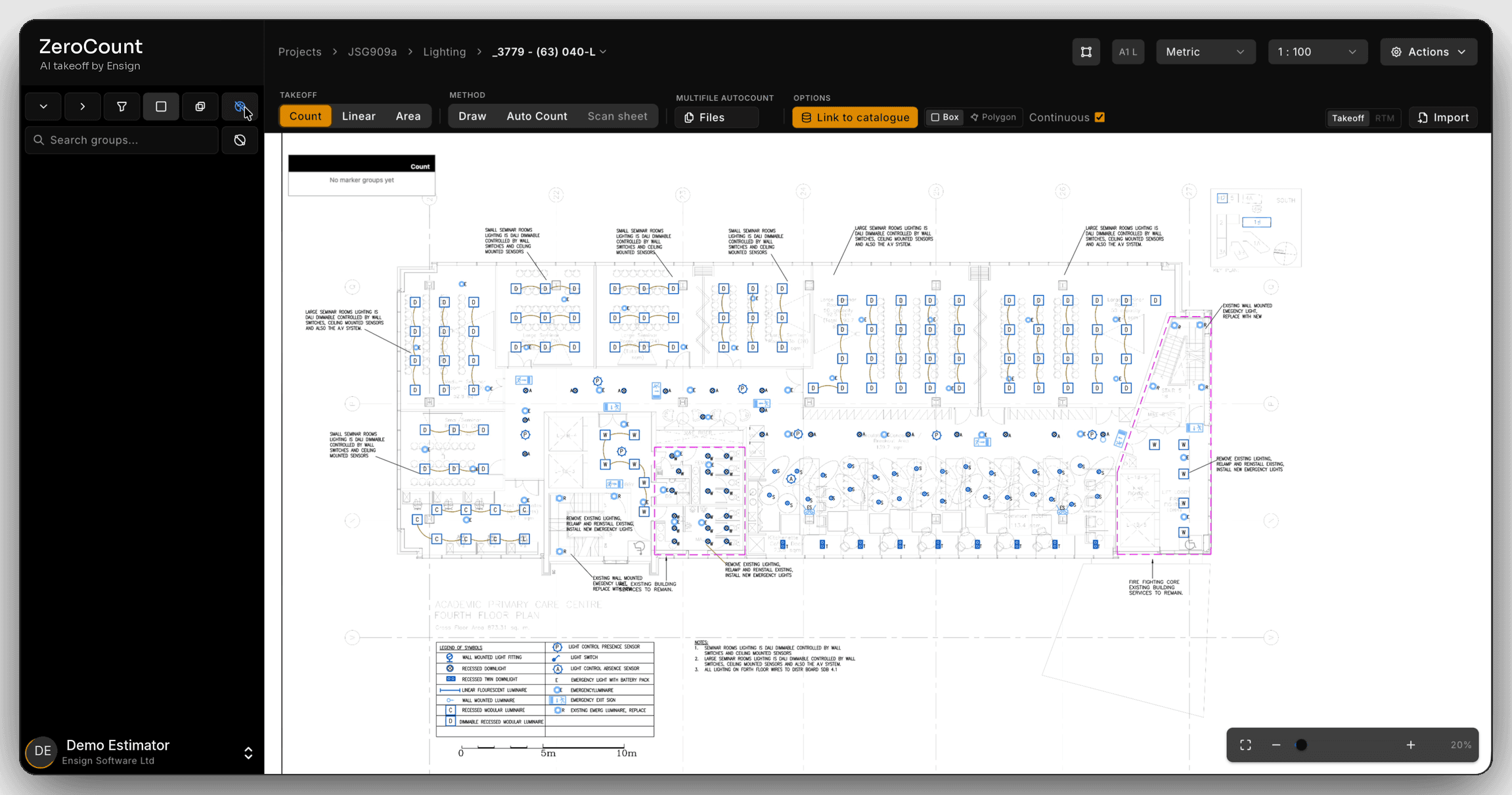
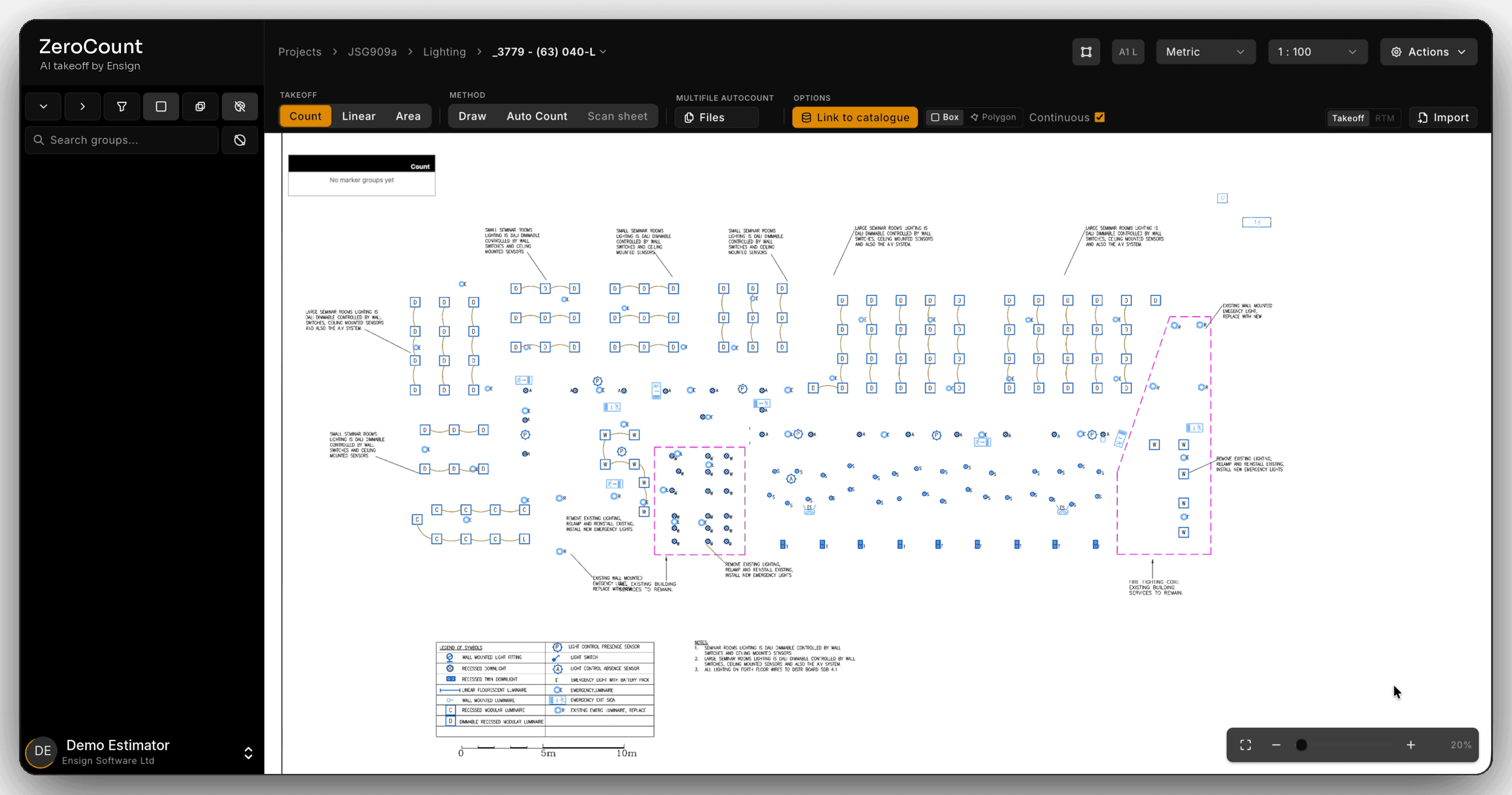
Background removal takes the walls and furniture off the drawing and keeps the symbols. Click one cable line and every cable line goes with it.
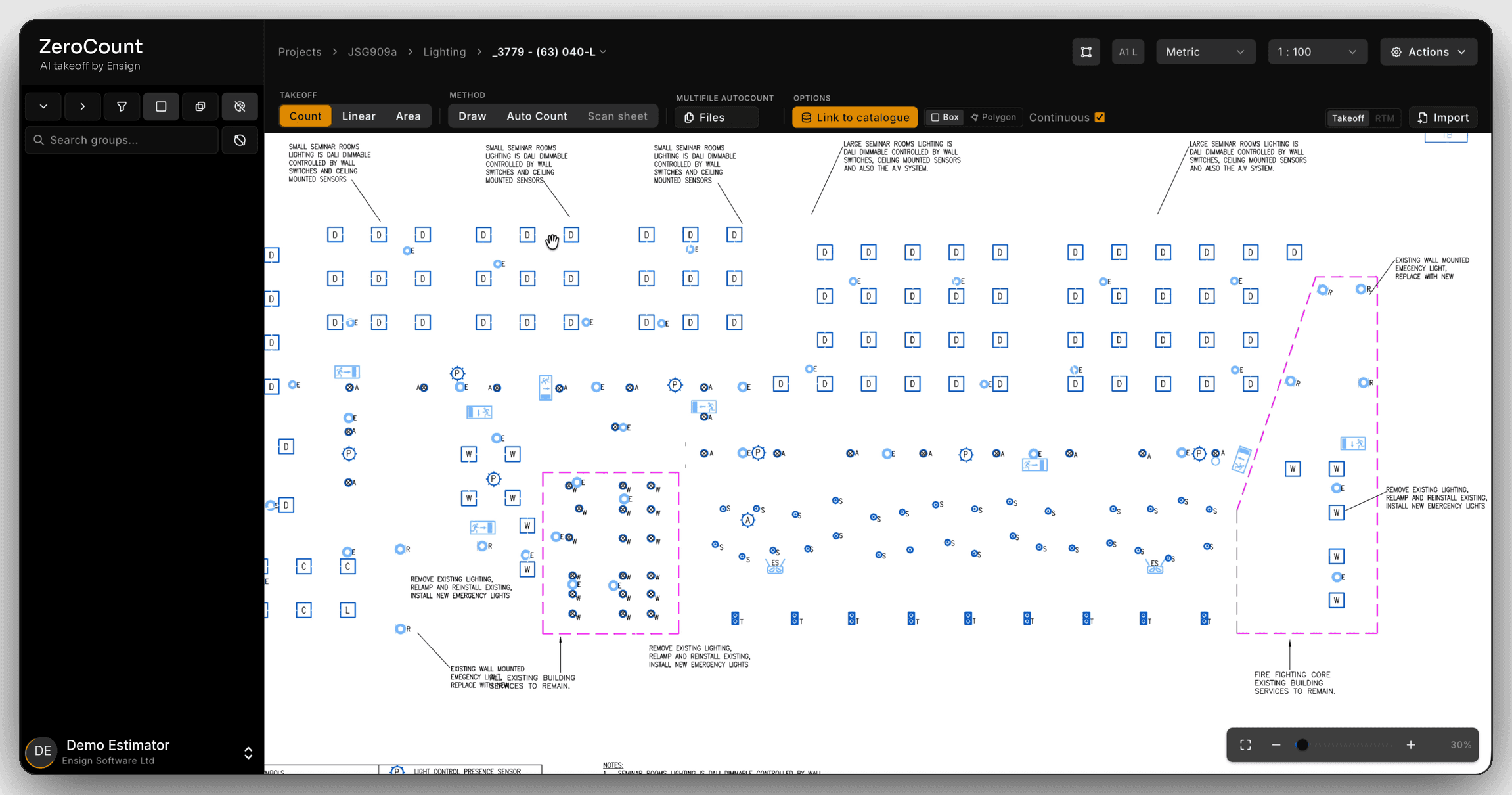
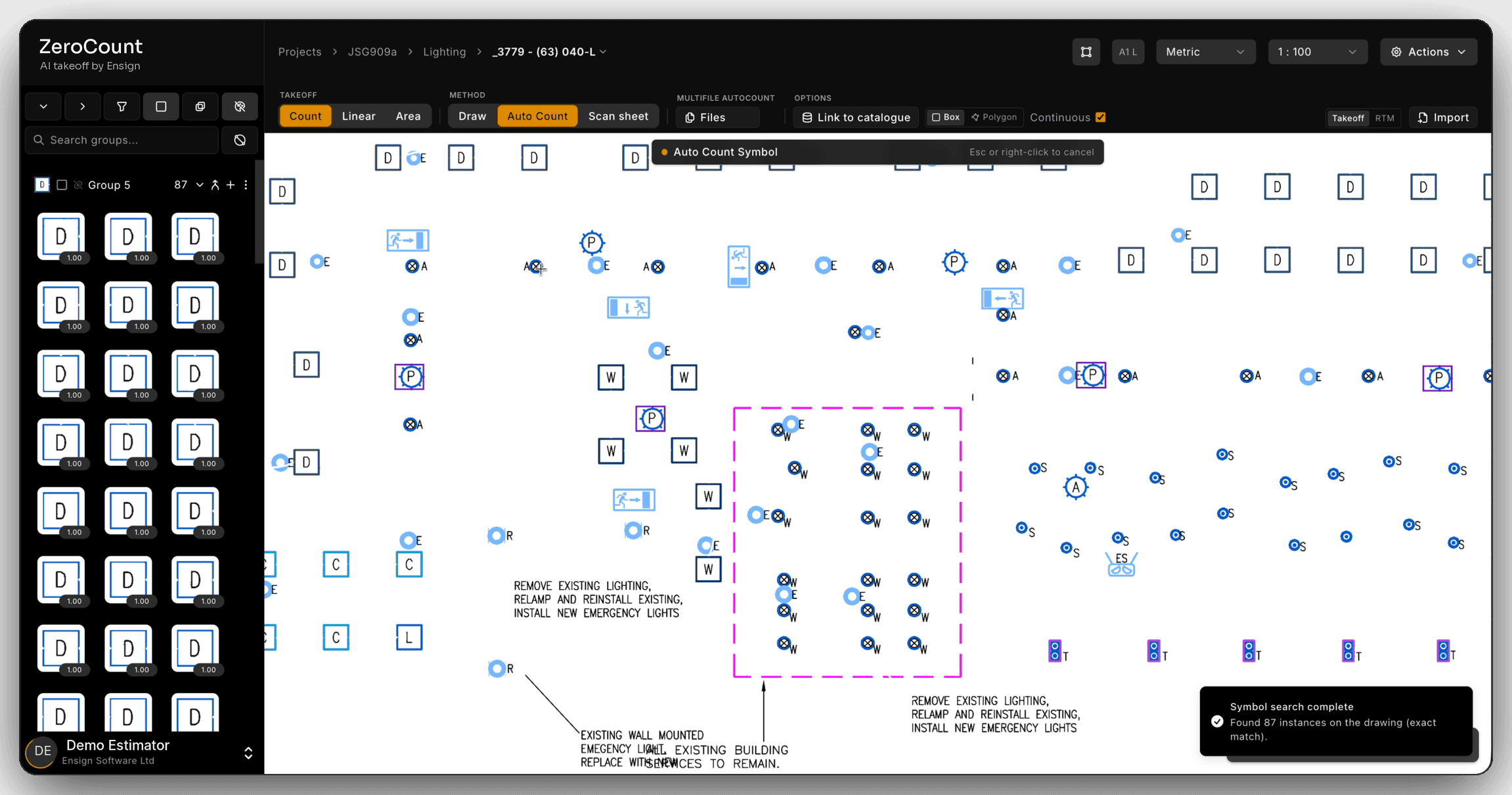
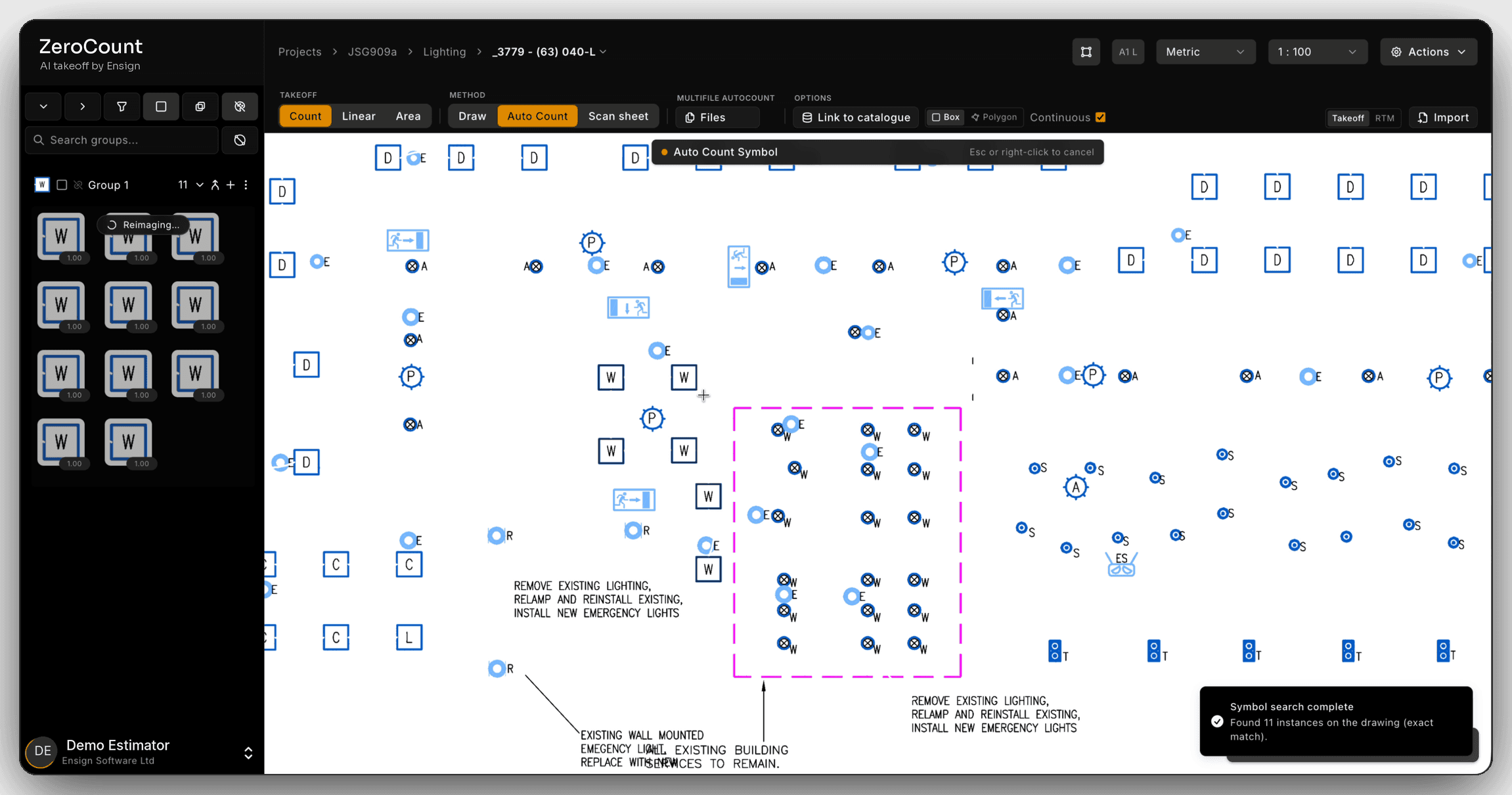
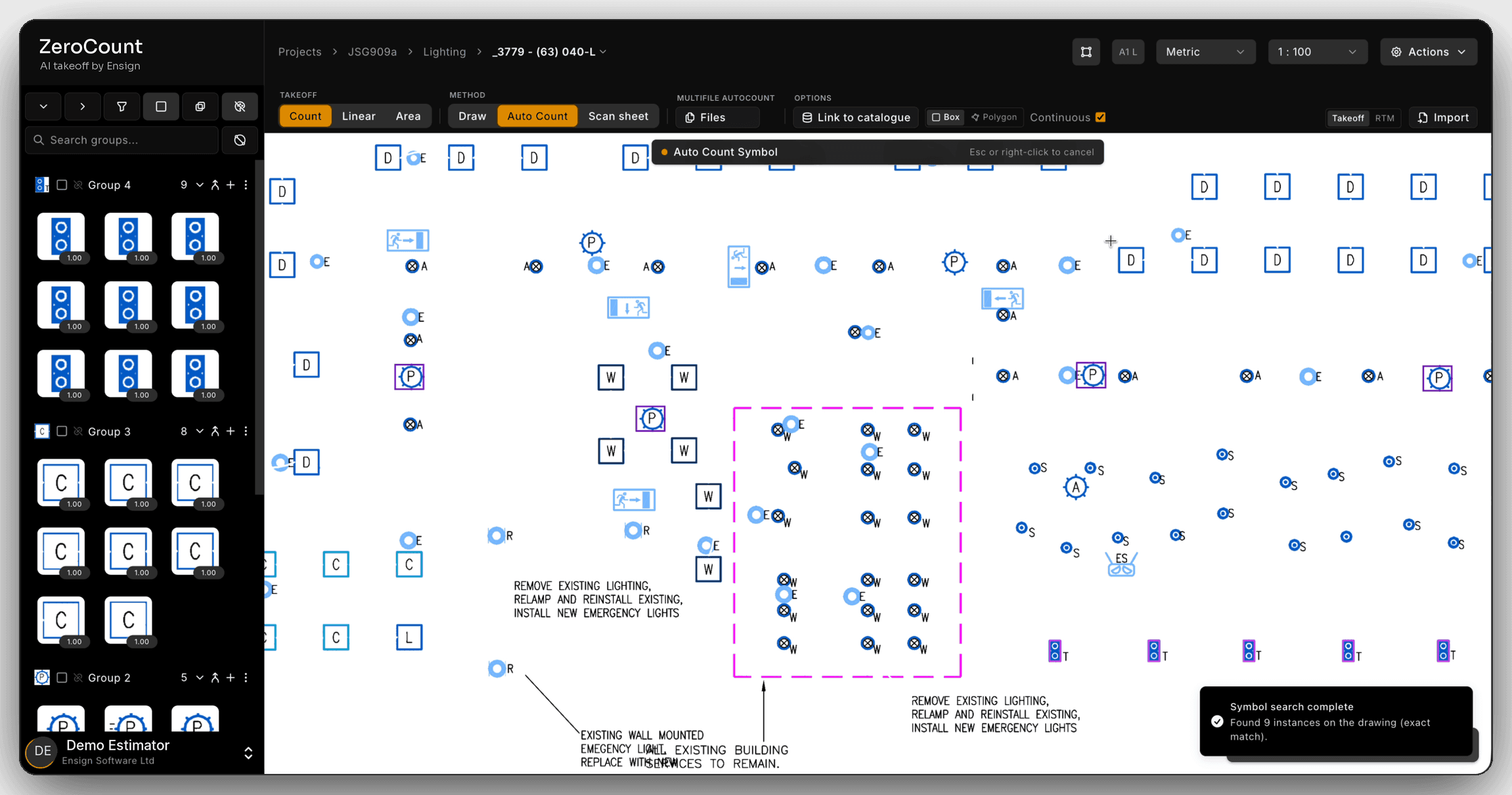
Pick one symbol. Every match is counted.
Pick a fitting on the drawing and ZeroCount finds the rest on the sheet, each type in its own group, each match marked where it sits.
Quick answers.
- Do I have to set up a symbol library before it counts anything?
- No. It reads the conventions on UK electrical drawings rather than matching against a library you maintain, so the first job with an unfamiliar consultant costs you what the tenth one does. Where it meets a symbol it has not seen, it takes one or two corrections rather than a library update.
- Does it separate emergency luminaires from the standard fittings?
- Yes. Luminaires come out counted by type — Cat 2 panels, downlights, batten fittings, emergency luminaires — rather than as one total. Emergency is the split most worth getting right: it carries its own rate and its own commissioning, and it is usually drawn as the standard symbol with one extra mark.
- Can it tell a twin socket from a single, or a switched spur from an unswitched one?
- Yes. Accessories are counted by variant rather than lumped into one small-power figure — single, twin, fused, switched, each counted as itself. They price at different rates, so the breakdown is the answer and the total is not.
- How does it measure containment and cable runs?
- Along the route, by colour or layer, with lengths broken down by size — trunking, tray and basket. What it will not invent is what the plan does not contain: vertical drops and riser lengths are not in a plan view, so that allowance stays your call.
- Do you handle scanned PDFs and photographed plans?
- Yes. Vector PDFs, scanned PDFs, and photos of plans on a desk all run through the same engine. Electrical layouts suffer worst from a bad copy — several hundred symbols to a sheet, and the difference between two of them is often a single stroke — so a red-penned photocopy is the case worth testing us on.
- How does pricing work?
- £55 per licence per month. No tiers, no enterprise upsell. Unlimited drawings and unlimited symbols are inside that number, so a job drawn in a symbol set nobody here has seen costs the same as one that is not. Multi-licence rates available from five seats — bring the team size to the demo call.
- Innovate UK funded
- ICO registered
- CHAS accredited
- Constructionline
- Built in the UK
See ZeroCount on your own drawings.
Tell us a bit about you and we'll be in touch within one working day to set up a 30-minute walkthrough.