Ductwork takeoff software that measures rectangular and circular on their own terms.
Rectangular and circular runs measured by section size. Bends, transitions and branches counted as the fittings they are. Dampers and terminals located and totalled — from a vector PDF, a scan, or a photograph of the plan on a desk.
Clean-up, auto count and auto linear, 42 seconds. Watch it with a scene-by-scene breakdown.
Ductwork as it is actually drawn.
Ductwork is rarely the only thing on the sheet. The duct sits on a ceiling plan with the sprinklers, the lighting, the containment and the structure drawn over the top of it, and the copy you are pricing from is usually a revision of a revision. Symbol-matching tools want clean isolated geometry. That is not what lands in the inbox.
ZeroCount reads duct runs the way an estimator does — following the run, taking the size from the label at each change, and picking up the fittings, dampers and terminals along it. Rectangular and circular, single-line and double-line, vector PDF or a photograph of the plan on a desk.
Rectangular and circular are not the same measure.
Both are ductwork and both end up on the same summary sheet, but they are made differently and they price differently. Rectangular duct comes off the developed surface of the sheet — the girth of a section against its length — because the gauge, the stiffening and the shop time all follow from the size it was made at. Circular duct is priced by the metre in diameter bands, with the fittings enumerated as items alongside the run.
Either way, a length on its own converts to nothing. A hundred metres of rectangular duct might be two hundred square metres of sheet or six hundred, depending on the sizes it was made up from. ZeroCount measures duct runs by size, rectangular and circular, and returns the lengths broken down by section size rather than as one total — the girth follows from the size, so the area falls out of figures you already have.
The size changes down the run, and the rate changes with it.
A supply run leaves the air handling unit at something like 1000 × 400 and reaches the last diffuser at 300 × 200, stepping down at every branch that takes air out of it. On the drawing that is a size tag written along the run at each change, and between any two tags is one section, at one size, at one rate.
Measuring end to end and calling it one length goes wrong in the direction that hurts: the big sections at the plant end are the expensive ones, and averaging them into the small branch runs prices them as though they were 300 × 200. Plant, attenuators and dampers break the run as well, so a single duct drawn as one line can be six or seven priced sections by the time it reaches a terminal.
ZeroCount splits the run at each labelled size change and reports the sections separately, so the lengths land against the size band they were measured at.
Fittings are a count, not a length.
Straight duct is the cheap part. What makes one job dearer than another of the same length is what interrupts it.
Bends, transitions and branches. A fitting carries more sheet per metre than the straight it replaces, takes considerably more shop labour, and on square bends usually takes turning vanes with it. Eighty metres threading through a plant room with a fitting every two metres and eighty metres running clean down a corridor are the same figure and nothing like the same price.
Volume control and fire dampers. A volume control damper sits on a branch or behind a terminal and is there to be balanced. A fire damper sits where the duct crosses a compartment wall or floor, and it brings a frame, an access panel, fire-stopping and a commissioning record with it. Several priced lines hang off that one count, which is why it wants a location reference rather than a total.
Diffusers, grilles and terminal units. A four-way ceiling diffuser, a linear slot, a return grille and a VAV box are four rates rather than one terminal figure, and the size matters as much as the type. They also fix where the branch runs stop.
ZeroCount counts bends, transitions and branches with their angle and size, identifies dampers by symbol — volume control, fire, smoke — and records each with the location it was found at.
Single-line, double-line, and why the size label wins.
Ductwork gets drawn two ways, and estimators get both, often in the same package. A single-line drawing shows the run as a centreline with the size written along it. A double-line drawing shows the duct at its actual width, with the bends and transitions drawn out as geometry. Plant rooms and coordination sheets tend to be double-line; ceiling distribution tends to be single-line.
What does not change is where the size comes from. Even on a double-line drawing the number you price is the one written on the run, not the one a scale rule gives you — and by the time a set has been printed, scanned and photographed, whatever scale it started at is long gone. The double-line version tells you more about routing and fitting count; the label still tells you what the duct is.
ZeroCount takes the size from the label on the run, so the same duct measures the same either way, and it reads vector PDFs, scanned PDFs and photographs through one engine. Ceiling plans almost never arrive with only the ductwork on them — if the package you are pricing includes the services around it, that is what MEP takeoff is for.
Where the duct takeoff ends and the insulation takeoff starts.
Most ducted systems get insulated, and duct insulation is measured by area over exactly the ductwork you have just counted — the same sections, the same sizes, the same fittings. The thickness comes from the spec rather than from the duct, so one run can carry thermal insulation along its whole length and acoustic lining only where it crosses a compartment: two measures over one drawn route.
Taking both off the same read of the sheet beats re-measuring later. When the duct sections and the insulation areas come from the same geometry the two bills reconcile, and nobody is arguing about whether the lining was priced against the run that was installed. Insulation takeoff covers how the specs are read off the drawing and matched to the runs, and mechanical takeoff covers the pipework, valves and plant the duct package sits alongside on the same M&E set.
Lengths by size, fittings by type.
Duct lengths by size
Rectangular and circular. Lengths broken down by section size — straight to your rate sheet.
Diffusers, grilles, terminal devices
VAV boxes, ceiling diffusers, return grilles. Counted by type and size.
Damper counts
Volume control, fire, smoke. Identified by symbol and counted with their location reference.
Branches, bends, transitions
Counted with their angle and size — fittings drive a real chunk of the cost on a ductwork bid.
Every pipe run traced and sized.
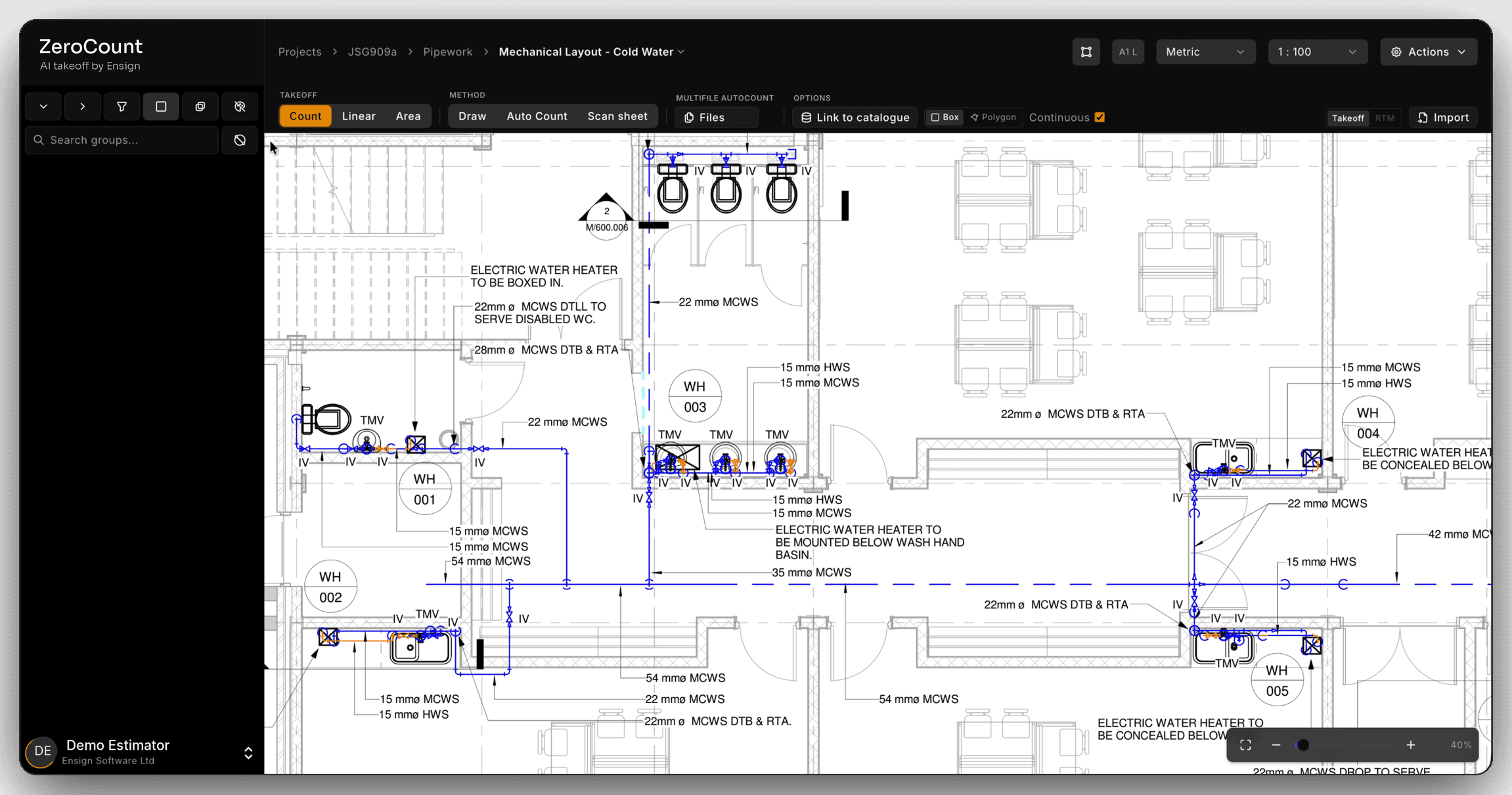
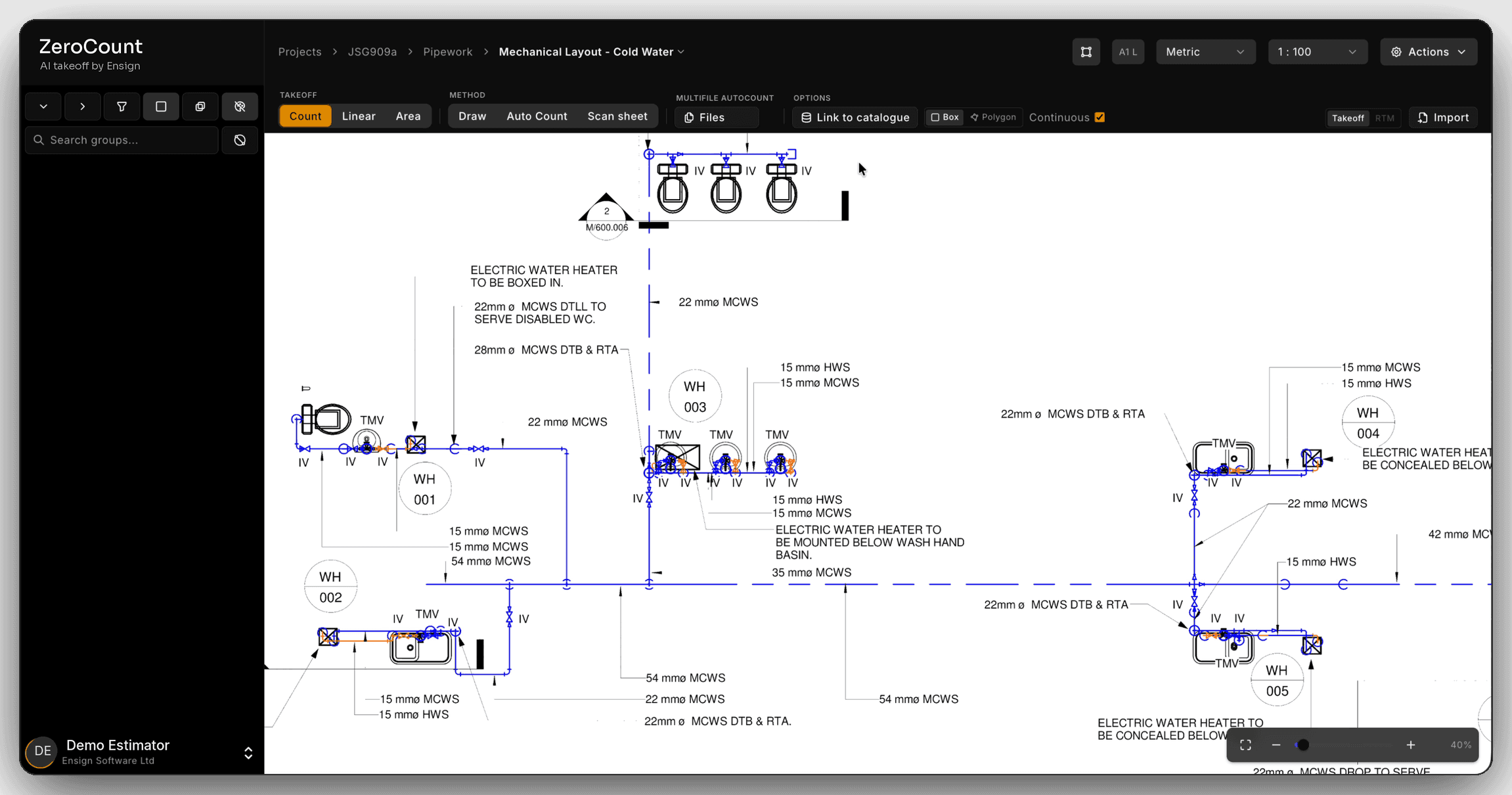
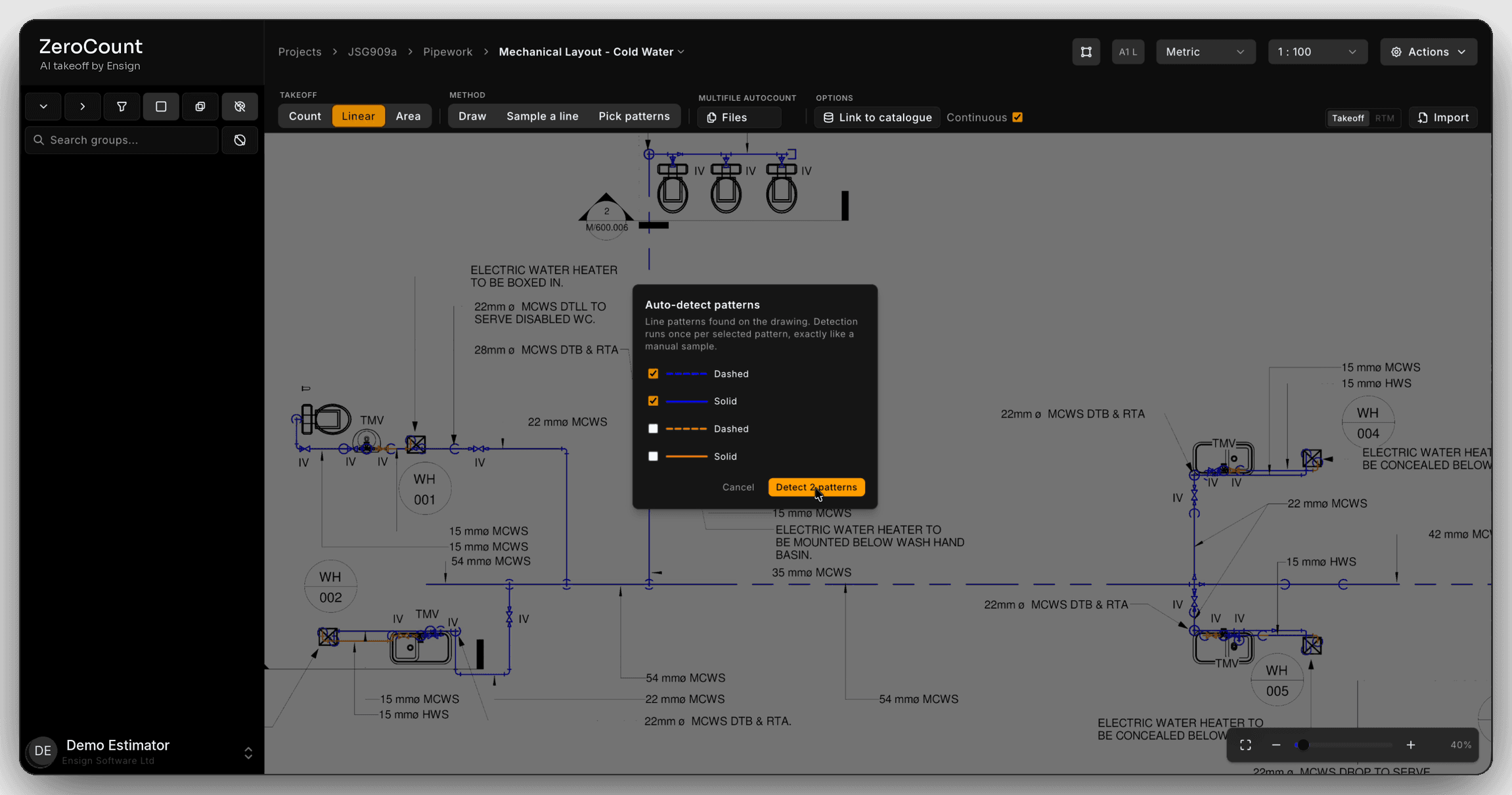
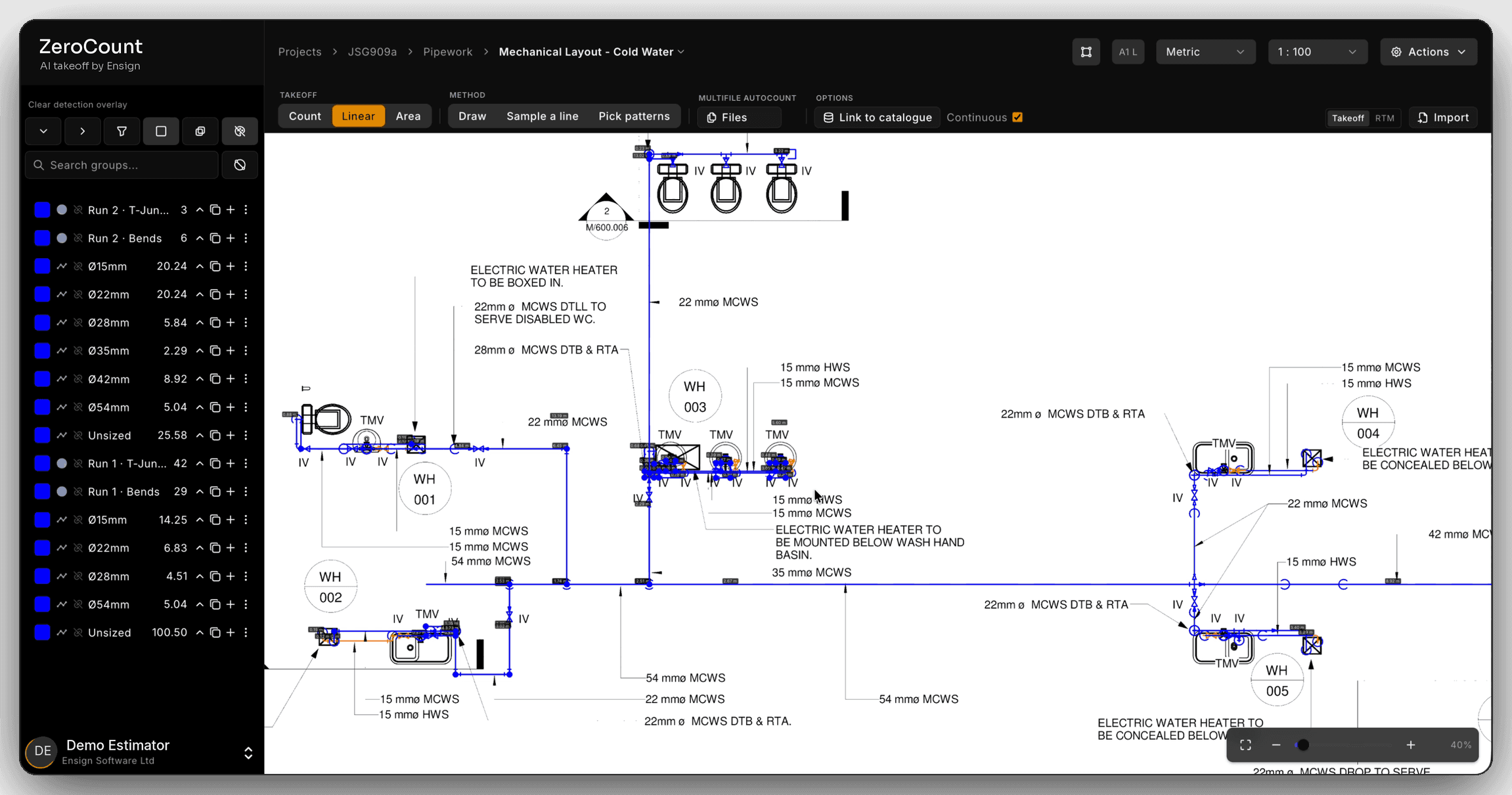
Clear the background, pick the line patterns to follow, and every run is traced and sized from the sizes written on the drawing, with the bends and tees counted along the way.
Quick answers.
- Is rectangular duct measured by area or by length?
- Lengths, split by section size — for rectangular and circular both. The girth follows from the size, so the developed area comes out of figures you already have. What you do not get is one total metre count with the sizes averaged into it, which is the version nobody can price.
- Does it break the run where the duct size changes?
- Yes. A run that leaves the AHU at 1000 × 400 and reaches the last diffuser at 300 × 200 comes back as the sections it was actually made up from, split at each labelled size change, rather than as one length at an averaged size.
- Are bends and transitions counted separately from the straight?
- Yes — counted with their angle and size. Fittings carry more sheet and far more shop labour per metre than the straight they interrupt, so eighty metres through a congested plant room and eighty metres down a clear corridor are the same length and nothing like the same price.
- Can it tell a fire damper from a volume control damper?
- Yes. Dampers are identified by symbol — volume control, fire, smoke — and counted by type with the location they were found at, because a fire damper drags an access panel, fire-stopping and a commissioning record along behind it. What it will not do is decide that a damper missing from the drawing should have been there. That one goes back to the design team.
- Do you handle scanned PDFs and photographed plans?
- Yes. Vector PDFs, scanned PDFs and photos of plans on a desk all run through the same engine. Ductwork sheets are the ones with every other service drawn over the top and the most revisions behind them, so the messy copy is the one worth testing us on.
- How does pricing work?
- £55 per licence per month. No tiers, no enterprise upsell. Multi-licence rates available from five seats — bring the team size to the demo call.
- Innovate UK funded
- ICO registered
- CHAS accredited
- Constructionline
- Built in the UK
See ZeroCount on your own drawings.
Tell us a bit about you and we'll be in touch within one working day to set up a 30-minute walkthrough.